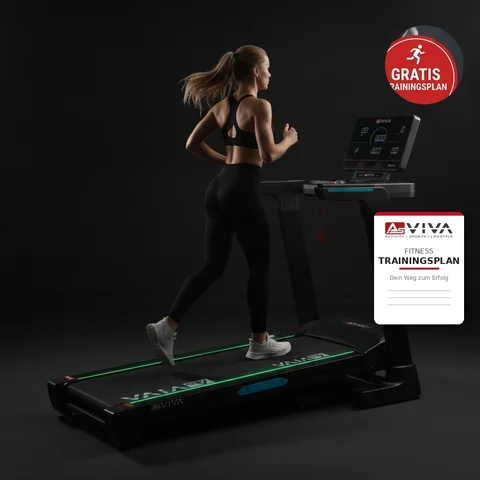
At first glance, a walking pad and a classic treadmill look similar – both feature a running belt, a motor, and a speed display. In practice, however, they serve two completely different purposes. Below, you will discover the technical differences, the pros and cons of each design, and which device truly suits your daily routine.
The Difference in One Sentence
A walking pad is built for walking; a treadmill is built for running. Everything else – motor power, running surface size, incline, height – follows from this single decision.
Walking Pad or Treadmill – The Differences at a Glance
The most important specs in direct comparison:
| Feature | Walking Pad T25 | Treadmill T16 |
| Speed | 0,5 – 6 km/h | 1 – 18 km/h |
| Motor power | 2 HP continuous output | 3 HP continuous / 4 HP peak output |
| Running surface | 120 cm length | 46 cm width, with handrails |
| Incline | 0 – 5 % | 0 – 18 % |
| Dimensions | 121,7 x 56 x 12 cm | 175 x 80 x 143 cm |
| Folded | 82 x 54,7 x 12,9 cm | foldable, but full height |
| Max. user weight | 100 kg | 150 kg |
| Handrails | no | yes |
| Control | Remote control | On-device console |
Advantages of a Walking Pad
- It disappears out of sight. With a folded height of just 12,9 cm, the T25 fits under a sofa or bed. A treadmill stays where it is.
- It fits under your desk. Without handrails and with an overall height of 12 cm, it can be used sitting or standing at your workstation.
- Quiet operation at low speeds. At 3–5 km/h, the motor runs well below its limit – crucial in rented apartments and upper floors.
- Low barrier to entry. Unfold, grab the remote control, and go. No navigating through a console with twelve programs.
- Significantly lower weight. A walking pad can easily be carried by one person, whereas a treadmill usually cannot.
Disadvantages of a Walking Pad – An Honest Look
- Tops out at 6 km/h. Jogging is not possible, and this is not a software restriction, but a matter of motor capacity and cushioning.
- No handrails. Anyone who feels unsteady, is recovering from surgery, or has balance issues needs something to hold onto.
- 100 kg user weight limit. Classic treadmills typically support 150 kg or more.
- Incline only up to 5 %. For incline walking as a training stimulus, this is on the lower end.
- Small display. No heart rate, watt, or program-based controls.
Advantages of a Classic Treadmill
- Any speed up to 18 km/h and beyond. Intervals, tempo runs, marathon preparation – all on the same machine.
- Real incline. 18 % on the T16, 20 % on the T20, up to 42 % on the T23 Pro Climb. Incline is the most effective way to increase training intensity without running faster.
- Larger running surface and cushioning. Running exerts multiple times your body weight – the deck is specifically engineered for this impact.
- Handrails and safety key. Essential at high speeds and for rehabilitation purposes.
- Higher maximum load. 150 kg is standard on our treadmills; the T22 supports up to 180 kg.
Disadvantages of a Classic Treadmill – An Honest Look
- Requires permanent space. Even when folded, a treadmill remains a full-height piece of equipment.
- Weight. Ranging from 73,8 kg for the T16 to 218 kg for the T22 – moving it is no casual task.
- Noise level. Running generates footfall noise and motor sound. In apartments with thin walls, this is a real factor.
- Higher purchase price. High-performance motors, robust frames, and advanced cushioning systems come at a price.
The Middle Ground: 2-in-1 Devices
Positioned between both worlds are 2-in-1 models. The 2in1 Walk & Run Treadmill T21 reaches speeds from 1–12 km/h and can be used as a walking pad with the handrail folded down or as a treadmill with the handrail raised. Setup dimensions 151 x 81 x 135 cm, 35 kg, up to 100 kg user weight capacity, 2,5 HP continuous output.
This is the ideal compromise if you mostly walk but want to jog lightly on occasion – but not the right choice if you run fast on a regular basis.
Our Devices at a Glance
Walking Pad & Treadmill Smart T25
0,5–6 km/h, 0–5 % incline, 120 cm running surface, 12 workout programs, Bluetooth, remote control. Folded height 12,9 cm. → To the Walking Pad T25
2in1 – Walk & Run Treadmill T21
1–12 km/h, 2,5 HP continuous power, foldable, 35 kg, up to 100 kg. → To the T21
Treadmill Smart Run T16
1–18 km/h, 0–18 % incline, 46 cm running surface width, 3 HP continuous power, 12 workout programs, Bluetooth, Kinomap and Zwift, up to 150 kg. → To the Treadmill T16
Treadmill Smart T18 Pro
1–18 km/h, 0–15 % incline, running surface 52 x 135 cm, foldable, up to 150 kg. → To the Treadmill T18 Pro
Treadmill T23 Pro Climb Treadmill
Run mode up to 18,8 km/h, Climb mode 1–6 km/h, incline −1 to 42 %, running surface 48 x 140 cm, 6 HP continuous power. For anyone who takes incline walking seriously. → To the T23 Pro Climb
Conclusion: Which One Is Right for You?
Walking Pad, if your goal is daily movement: 8.000 steps at your desk, walking while watching TV, a small apartment, no dedicated workout space.
Treadmill, if you run or want to start running: building endurance, intervals, incline training, body weight over 100 kg, or the need for handrails.
2-in-1, if you don't want to choose between the two and primarily walk.
An overview of all models can be found in our Treadmills and Walking Pads categories.
Your Workout Plan to Go
We have an 8-week plan available as a PDF for both design types. Free, no registration required – and tailored specifically to your machine's capabilities.
Overview of all plans: Workout Plans
FAQ: Frequently Asked Questions About Walking Pads and Treadmills
Can you jog on a walking pad?
No. Our T25 tops out at 6 km/h, and this limit is intentional: the motor, running surface thickness, and cushioning are designed specifically for walking. For jogging, you need a treadmill.
Is a walking pad quieter than a treadmill?
Under comparable use, yes – mainly because walking produces significantly less footfall impact noise than running. The largest portion of noise in an apartment comes from foot impact rather than the motor.
How much space does a treadmill really need?
Plan for the footprint plus about one meter of clearance behind it. For the T16, that means a 175 x 80 cm device plus safety distance. A walking pad requires 121,7 x 56 cm during use and zero space afterward.
Is a walking pad worth it for weight loss?
It depends on total daily duration, not the intensity of a single workout session. Someone who walks two hours a day alongside work burns more energy than someone running 30 minutes twice a week. The main advantage of a walking pad is its seamless integration into everyday life.
What is Incline Walking?
Walking at an incline. It significantly increases engagement of the glutes and hamstrings without the joint stress associated with running. A walking pad achieves up to 5 % – if you want more, you need a treadmill with true incline adjustment.