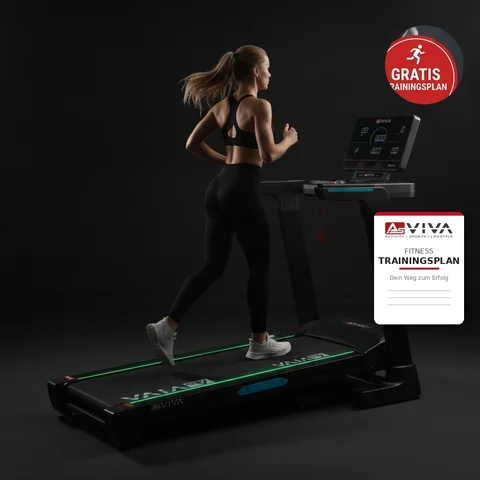
Rowing machine or treadmill – this question usually comes up when there is room for exactly one piece of equipment. Both train endurance, but they do so using different muscles, different levels of joint stress, and very different space requirements. The difference is greater than it might seem at first glance.
The Difference in One Sentence
Rowing pulls with the whole body; running supports the whole body. When rowing, roughly four-fifths of your muscles are actively working without putting a single impact on your joints. Running mainly targets the legs – but on the plus side, it is the movement closest to daily life.
Rowing Machine vs. Treadmill – Overview of Differences
| Feature | Rowing machine | Treadmill |
| Muscles targeted | Legs, glutes, back, core, arms, shoulders | Legs, glutes, core |
| Joint impact | None | With every step |
| Weight of equipment (our models) | 29 – 50 kg | 94 – 218 kg |
| Dimensions (in use) | 195 – 272 cm long, 52 – 116 cm high | 157 – 208 cm long, 144 – 168 cm high |
| Storage | foldable, some store upright | some foldable, remains bulky |
| Technique required | Yes – sequence: legs, core, arms | No – anyone can walk |
| Transfers to | Rowing, strength endurance, posture | Outdoor running, hiking, everyday life |
Why Equipment Weights Vary So Significantly
A treadmill has to support a runner landing with two to three times their body weight – requiring a sturdy frame, cushioning, and a motor. That is why our treadmills weigh between 94 kg (Smart T18 Pro) and 218 kg (Studio Pro T22). A rowing machine doesn't carry your weight; it only handles pulling force: The Water Rowing Machine RA18 weighs just 29 kg and can be stored upright in a corner. If you want to store your equipment away between workouts, there is really only one choice here.
Advantages of a Rowing Machine Over a Treadmill
- Full-body workout in a single motion. Legs drive, core opens, arms pull – sequentially in one fluid movement. Hardly any other cardio machine engages so much muscle.
- Zero impact. For knees, hips, and ankles, rowing is one of the gentlest forms of exercise available.
- Easy to store out of sight. 29 to 50 kg, foldable, with some models storable upright.
- Trains your posterior chain. The back and rear shoulders are often neglected in daily life – and they are precisely what work during the pull.
Disadvantages of a Rowing Machine Over a Treadmill
- Proper technique is essential. Pulling with a rounded back or relying solely on your arms leads to ineffective workouts and risks injury. Your first few sessions should focus on correct sequence, not speed.
- Requires more length in use. 195 to 272 cm during workouts – longer than a treadmill. But unlike a treadmill, it doesn't take up that space permanently.
- Less transfer to everyday activity. If you are training for a run, a treadmill practices the exact movement you need.
Advantages of a Treadmill Over a Rowing Machine
- Anyone can start right away. Walking and running require no learning process. This reduces the learning curve to zero.
- Incline as an added challenge. Up to 15% on the Smart T18 Pro – turning a walk into a challenging workout without increasing speed.
- Direct transfer to outdoor activities. If you are training for a run or a hike, you are practicing the actual movement.
- Bone-density benefits. The very impact that taxes your joints also stimulates bone metabolism – a benefit that rowing does not provide.
Disadvantages of a Treadmill Over a Rowing Machine
- The impact. For those with knee problems, severe overweight, or recovering from an injury, impact is the main limiting factor.
- Weight and size. 94 to 218 kg. A treadmill stays right where you place it.
- Impact noise transmitted to neighbors. Footsteps travel through the frame into the floor below – the most common complaint in apartment buildings. Find out how to reduce this noise in our article How Loud Is a Treadmill?
- Legs only. Upper body and arms get little to no workout.
Which One Is Right for You?
- Limited space, machine needs to be storable: Rowing machine.
- Knee issues or significantly overweight: Rowing machine – zero impact.
- Goal is training for a run, a hike, or better outdoor endurance: Treadmill.
- Want to target back and improve posture: Rowing machine.
- Want to get started with no learning curve: Treadmill.
- Apartment with neighbors below: Rowing machine – or a treadmill with a floor protection mat.
Overview of Our Equipment
Water Rowing Machine RA18 Lightning
29 kg, dimensions 195 × 51.8 × 52 cm, foldable and storable upright, 16 workout programs, up to 150 kg maximum user weight. Water resistance: The harder you pull, the greater the resistance. → To the RA18 Lightning
Rowing Machine & Ergometer RA10 Pro
Two machines in one – rowing and cycling. 50 kg, 272 × 52.5 × 110 cm, foldable, up to 150 kg maximum user weight. → To the RA10 Pro
Rowing Machine Magnetic Rower RA14
45 kg, 13 kg flywheel mass, magnetic resistance, up to 150 kg maximum user weight. The perfect entry into rowing. → To the RA14
Treadmill Smart T18 Pro
1 to 18 km/h, incline up to 15%, 94 kg, dimensions 197 × 90 × 144 cm, foldable, up to 150 kg maximum user weight. → To the Treadmill T18 Pro
Treadmill Studio Pro T22
Our largest model: 1 to 20 km/h, 7 HP continuous power, up to 180 kg maximum user weight, 218 kg net weight. This machine requires a permanent spot – and a floor that can support the weight. → To the Treadmill T22
Download Your Workout Plan
An 8-week PDF plan is available for both machine types. Free of charge, no registration required.
Overview of all plans: Workout Plans
FAQ: Frequently Asked Questions About Rowing Machines and Treadmills
Which workout engages more muscles – rowing or running?
Rowing. Legs, glutes, back, core, arms, and shoulders all work together in a single movement; roughly four-fifths of your muscles are engaged. When running, the percentage is significantly lower because the upper body primarily serves to stabilize.
Which machine requires less space at home?
In use, the treadmill; for long-term storage, the rowing machine. A rowing machine is longer while in use (195 to 272 cm), but can be folded and in some cases stored vertically afterwards – easily done by one person thanks to its weight of 29 to 50 kg. A treadmill weighs 94 to 218 kg and stays where it is.
Is rowing difficult to learn?
The basic movement requires some practice, but it is easy to grasp: first drive with the legs, then open the core, finally pull with the arms – and return in reverse order. The first two or three workouts should focus on getting the sequence right rather than speed. After that, it comes naturally.
Which is better for knee problems?
The rowing machine. There is zero impact, and force is distributed across the entire leg extension rather than concentrated in a single impact. On a treadmill, impact can be reduced by walking instead of running and by using an incline instead of speed, but it cannot be eliminated entirely.
Can I train for a run on a rowing machine?
For cardiovascular endurance, yes; for the running motion itself, no. Your cardiovascular system benefits regardless of the machine. However, the specific strain placed on tendons, ligaments, and bones during running can only be conditioned through running – so if you are preparing for a run, a treadmill is essential.
How long should a workout session last?
For beginners, 20 to 30 minutes, three to four times a week. When rowing, shorter sessions with proper technique are better than long sessions with a rounded back. Specific guidelines can be found in the two workout plans linked above.