Anyone training at home thinks about space and price first. But the question that ultimately decides whether equipment actually gets used is a different one: How loud is it? If you live in an apartment with neighbors below, train in the evening, or have a sleeping child in the next room, you simply cannot afford noisy equipment. Below, we explain how loud exercise equipment actually is, where the noise comes from, and which design works for which living situation.
The Short Answer
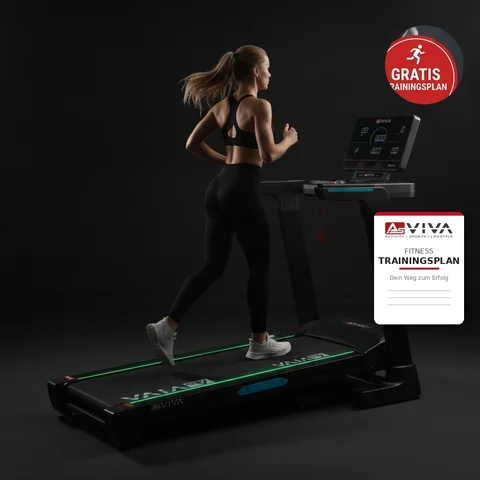
A modern treadmill operates at around 50 decibels. For our Studio Pro T22 Treadmill, we measured 48 to 53 dB as a continuous sound level at a distance of one meter. This is roughly equivalent to a quiet conversation in the next room.
Equipment without a motor and without foot impact – ergometers, cross trainers, rowing machines, Speedbikes – is significantly quieter. With these, you mostly hear your own breathing. This is not a marketing pitch, but a result of their design: They operate with belt drives and magnetic resistance, meaning no parts touch each other.
What Decibels Mean
The number alone doesn't say much. Here are a few everyday values for comparison:
| Decibels | Roughly equivalent to |
| 30 dB | Whispering, very quiet bedroom |
| 40 dB | Quiet refrigerator, quiet library |
| 50 dB | Quiet conversation, rain outside the window |
| 60 dB | Normal conversation, dishwasher |
| 70 dB | Vacuum cleaner, busy street |
Distance is crucial: The specification “at one meter” is part of the measurement. Two meters further away, the same value is about 6 dB lower. And decibels are not an ordinary linear scale – 60 dB is not twice as loud as 30, but perceived as roughly eight times louder. Anyone reading a manufacturer's specifications without distance and measurement method should therefore treat them with caution.
Where the Noise Comes From
With fitness equipment, there are exactly three sources of noise, and some are easier to manage than others.
- The drive. All our cardio equipment operates via a belt, not a chain. A belt grips over a wide surface instead of link by link – it doesn't rattle and requires no oil. On a treadmill, the motor is added; an inverter control like in the T22 regulates it seamlessly instead of starting it abruptly.
- The resistance. Magnetic means: A magnet brakes the flywheel without touching it. There is no friction, meaning no grinding noise and no wear. Only older or very basic equipment still brakes via felt pads – these are audible and wear out.
- The foot strike. This is the main cause, and it isn't listed on any spec sheet: structure-borne noise. A foot striking a treadmill transfers the impact through the frame into the floor and from there into the neighbor's ceiling. You barely hear this part yourself – but downstairs, it's clearly noticeable.
This leads to a rule of thumb that is surprisingly reliable: What touches the floor is the problem – not the technology inside the device.
Equipment Types from Quietest to Loudest
Quietest: Ergometers, Cross Trainers, Speedbikes
On these machines, you sit or stand; there is no impact. A belt drive plus magnetic resistance means nothing touches during operation. What remains is a quiet hum from the flywheel – and your own breathing, which is usually louder than the machine. A heavy flywheel mass actually helps: It runs smoother and therefore quieter than a light one.
Quiet with a Distinct Sound: Water Rowing Machines
A water rowing machine produces no mechanical noise, but rather a swooshing sound – the paddles move water inside a tank. The sound level is low, but the sound is unmistakable. Many find it pleasant, some distracting. It's difficult to express this in decibels; the only way to know is to try it out.
Quiet as Long as You Walk: Walking Pads
A walking pad goes up to about 6 km/h. When walking, the foot strike is soft, and the motor operates in a low range – making the machine apartment-friendly, even in a home office next to your desk. If you want to jog on it, you lose this advantage immediately: As speed increases, so do the impact and motor load.
Loudest: Treadmills
A treadmill combines both noise sources – motor and foot impact. The measured 48 to 53 dB of the T22 describes operation; the impact during running comes on top of that. That's why a treadmill is the only piece of equipment where the floor surface is truly crucial.
Our Equipment and What We Know About Noise Levels
We only state what we can substantiate here.
- Treadmill Studio Pro T22 – measured 48 to 53 dB (continuous sound level, one meter distance). Inverter motor control for smooth starts.
- Treadmill T30 Pro Max – below 50 dB.
- Walking Pad & Treadmill Smart T25 – designed for walking speeds, making it the quietest machine with a running surface in everyday use.
- Water Rowing Machine RA18 Pro – water drive, swooshing sound instead of mechanics.
- Speedbike Studio Pro S17 – 28 kg flywheel mass, magnetic resistance, belt drive.
For our other equipment, we do not have our own measurements. We prefer not to state anything rather than providing a figure we haven't verified.
What Really Helps in an Apartment
The most effective measure costs under one hundred euros and isn't found on any spec sheet.
- A floor protection mat. It decouples the frame from the floor screed and absorbs the exact structure-borne noise that reaches your neighbor. This makes more of a difference than any choice of motor. We offer them in 192 × 95 cm and 136 × 67 cm.
- The location. Placing it against a load-bearing wall is better than in the center of the room, where the floor flexes the most. A carpet underneath helps further, but does not replace the mat.
- Leveling the machine. If it stands even slightly uneven, the frame flexes with every movement – creating creaks and transmitting vibration.
- The time of day. Most house rules mandate quiet hours between 10 p.m. and 6 a.m. as well as during lunchtime. An ergometer is barely noticeable, but a treadmill certainly is.
Conclusion: What Suits Your Living Situation?
- Rented apartment with neighbors below you: Ergometer, cross trainer, or rowing machine. No impact, no issue.
- Home office, wanting to move while working: Walking pad. Quiet enough to talk on the phone while using it.
- You want to run and don't live on the ground floor: Treadmill plus a floor protection mat, and not late at night.
- Your own house or basement: Free choice. Then your workout preferences decide, not the noise level.
Your Training Plan to Go
We offer an 8-week plan as a PDF for every type of equipment. Free, no registration required – and calculated with the values your machine can actually deliver.
All plans at a glance: Training Plans
FAQ: Frequently Asked Questions About Noise Levels of Exercise Equipment
How loud is a treadmill in decibels?
For our Studio Pro T22 Treadmill, we measured 48 to 53 dB as a continuous sound level at a distance of one meter. This is roughly equivalent to a quiet conversation. The impact sound when running comes on top of that and depends on weight, speed, and floor surface.
Which fitness equipment is the quietest?
Equipment without impact and without a motor: ergometers, cross trainers, rowing machines, and Speedbikes. They operate with a belt drive and magnetic resistance, with no touching parts. You usually hear your own breathing more clearly than the machine.
Does a treadmill disturb the neighbors below me?
Airborne sound is not the problem, but structure-borne noise: The impact of stepping travels through the frame into the floor screed. A floor protection mat decouples the machine from the floor and is the single most effective measure – more effective than choosing a different motor.
Can I take phone calls while using a treadmill in my home office?
On a walking pad at walking speed, yes – it stays below the volume of a normal conversation. On a classic treadmill at a running pace, it becomes difficult: The foot strike is audible through the microphone, even if it hardly bothers anyone in the room. If you need both, you are better off with a walking pad next to your desk. We have a detailed comparison of both types in a separate article: Treadmill or Walking Pad?
Is a water rowing machine quiet?
It is mechanically quiet, but has its own sound: the swooshing of water in the tank. The noise level is low, but the sound is clearly noticeable. Whether you find it pleasant is a matter of personal preference.
What does a floor protection mat actually do?
It absorbs the structure-borne noise that would otherwise travel into the ceiling below, protects the flooring, and keeps the machine level. For apartments, it is not just an accessory, but a vital part of the setup.
Can I work out in the evening after 10 p.m.?
On an ergometer, cross trainer, or rowing machine, it is usually not a problem. With a treadmill, the foot strike remains audible even with a mat – and most house rules specify quiet hours between 10 p.m. and 6 a.m. If in doubt, talk to your neighbors beforehand.