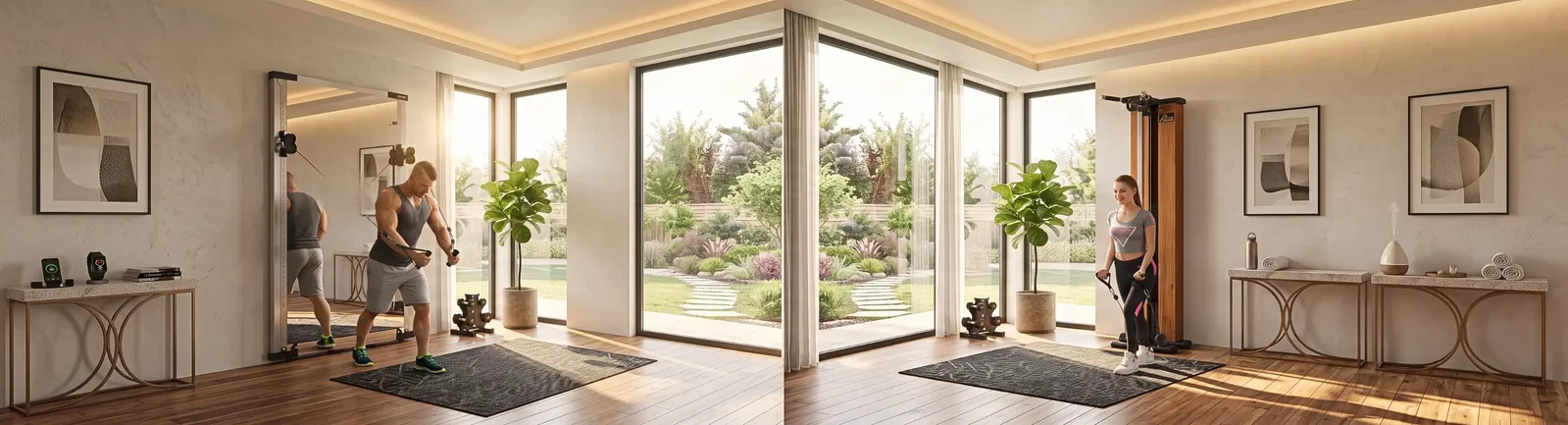
A home gym, also known as a multi-station or multi-gym, is an all-rounder for anyone looking to build strength at home. Such a station usually combines many individual exercise stations into a single functional fitness machine in a compact space. You can put together versatile workout sets that never get boring – while training with maximum time flexibility without having to travel to the gym first. AsVIVA offers both solid, affordable entry-level models as well as comprehensive professional models for all strength athletes.
Whether cable pulley station, multi-gym, or wall-mounted home gym: as a cable machine, a multi-gym requires less footprint than many expect. There are also suitable designs for small rooms – the MG9 can be mounted on the wall.
A home gym is also called a multi-station or multi-gym because it consists of multiple training areas. These are often centered around a heavy, solid steel structure surrounded by a variety of exercise areas. Hence the name multi-station: multiple workout stations are combined within a space-saving and effectively designed training area. Unlike a single-purpose machine, a home gym allows you to target major muscle groups and create an effective workout plan for versatile strength training.
In its basic version, such a multi-gym can consist of just a few components – for example, a cable pulley system plus a fold-out workout and weight bench. Nevertheless, even with such a streamlined version, a varied full-body workout can be performed, as all components are well thought out and designed to be as versatile as possible. The high-end version of a multi-gym, on the other hand, can boast several dozen exercise systems and maximum workout variety. Such professional models often impress with innovative technologies as well as exceptional comfort.
The basic functions that almost every multi-gym comes with
Regardless of whether you choose an entry-level model or a comprehensive, multifunctional multi-gym – all multi-gyms feature a kind of basic equipment that almost every model comes with. Apart from slim versions, where a cable pulley system forms the base and is merely supplemented by one or two accessories, a multi-gym from the mid-price range upward usually includes at least the following components:
Chest Press/Bench Press and/or Leg Press
Butterfly
Lat pulldown
adjustable flat bench with different incline angles
high and/or low cable pulley components
various handles and bars at different heights (for pull-ups or dips)
When it comes to features, the sky is the limit. Home gyms that feature a bench, pulley system, and an attachment for a barbell plus weight plates are especially popular.
Benefits of a multi-gym for muscle building
A home gym like this can be set up in many different ways – making one of its biggest advantages obvious right away: A multi-gym allows for countless exercise variations. Additionally, you can train major muscle groups in the smallest of spaces right in your own home. You can use a compact station to target specific muscle groups or support your entire musculoskeletal system by strengthening your stabilizing muscles all over. Or maybe you simply want to burn more calories through strength training and focus on weight loss. Every goal can be set individually. Here is an overview of the key benefits:
requires little to moderate space depending on features
you can train at home in peace and quiet at any time of day
flexible and highly individual training programs are possible
no travel time or waiting for equipment
many stations can be expanded with optional accessories
full-body workout at a professional level is possible
How much space is needed for a home gym?
An important buying criterion is the required floor space. Before buying, think about where in your home you want the home gym to be, and ideally measure the area. For the smallest basic stations you need around 2 to 3 square meters; most have a footprint of approximately 2,5 × 2,5 Meter.
Depending on the equipment, space requirements can be larger. Height is also important: most multi-gyms are 2 to 2.20 meters high. Allow about 20 centimeters of clearance to the ceiling as well as a movement radius of at least 1 to 1.5 meters around the equipment. A floor protection mat ensures a secure, non-slip stand and protects your floor.
Important features and functions
There are several features and training functions that are commonly built into a home gym:
Weight stack / pin system
You might recognize the sight from the gym: Exercises where a weight is pulled or pressed often run via a cable pulley system with pulleys to a weight stack. Each plate has a hole into which you insert a pin to define the weight. The further down the pin engages, the more weight you move during the exercise.
Plate-load system
In a system without a weight stack, the training weight is determined using free weight plates. Your home gym usually has storage pegs where plates of different kilogram weights are stored; you freely choose which weights to load. Such a system is often found on a Smith machine.
Smith machine
A central core element of many home gyms is the Smith machine. Here, a barbell loaded with weight plates is pressed upward within guide rails while you lie on the bench beneath it. The highlights: the ball-bearing barbell guide replaces a spotter, allowing you to train alone with maximum safety. On each side, there is a catch hook that locks the bar into place at any level with a twist. In addition, many Smith machines feature a safety function with customizable safety spotters to stop the barbell on its way down.
Leg curl and/or leg press
Many stations feature built-in elements for leg training or can be converted accordingly. A leg curl attachment is often connected to the bench. If leg exercises are important to you, make sure your equipment already includes this function or can be retrofitted.
Dip and pull-up function
A commonly built-in element includes two parallel, vertical bars with horizontal armrests at chest height for dips – as well as handles or a pull-up bar at the top for various pull-up exercises.
Cable machine
Almost every home gym has one or more cable pulleys integrated – either attached to the weight stack or operated via the plate-load system. Cable pulleys are extremely versatile: Through different angles and mounting heights, many muscles can be targeted specifically or in isolation. This makes them one of the most versatile exercise stations on a home gym.
Avoiding workout mistakes on home gyms
When training independently on a home gym, you should follow a few basic rules to avoid overexertion and self-inflicted injuries. The classic mistakes:
Skipping the warm-up: Make sure to warm up properly at home as well. Light jogging in place, jumping jacks, rowing (if a rowing machine is available), stretching exercises, or sets with very light weight work well.
Incorrect breathing: Basic rule – exhale during exertion, inhale during relaxation. Steady breathing is important; especially when training alone, it is easy to lose mindfulness.
Too much weight: Proper form ALWAYS comes before weight. As soon as you wobble, compensate, or have to stop early, it was too much. Start low and increase gradually.
No recovery breaks: Muscles need to recover from workout stimuli. The higher the intensity, the longer the rest. Rest days are essential for sustainable muscle building.
Choosing the right multi-gym
Budget and available floor space play the most important role when choosing – the home gym should
comfortably fit into the designated space. In addition, you should consider the following points:
Which functions and exercise stations should your multi-gym have? What needs to be included right away, and what can be added later via accessories?
Check the list of accessories and optional expansions if you want to upgrade later.
Brand name or off-brand: How important is a manufacturer's good reputation to you?
Muscle building or general strengthening: For targeted muscle growth, a Smith machine incl. free rack makes sense – there, the barbell can be used freely (e.g., for deadlifts).
Workout effectiveness: Pay attention to quality and optimal adjustability of weights and cable pulleys.
Manufacturer warranty: The longer the warranty, the more it speaks for the quality.
Workmanship & material: Solid, high-quality steel with a heavy net weight ensures a stable, secure stand.
Ideal for beginners and anyone with limited space: Despite its compact
footprint, the MG7 cable pulley station offers a wide variety of workout options – an ideal entry into strength training at home.
From compact slim models to fully equipped Smith machines: in our home gym overview, you will find the right multi-gym for your workout goals – high quality craftsmanship and complete with detailed assembly instructions.
Dual-sided cable pulley with up to 100 kg pulling weight
26 finely graduated weight blocks · various pulling directions
Fixed wall mounting – particularly space-saving at home
FAQ – Frequently asked questions about home gyms
Home gym or free weights?
A home gym is safe, space-saving, and guides your movement – ideal for home. Free weights require more stability and technique. A model like the MG7 offers many exercises in a single machine.
How much space do I need?
Plan for freedom of movement around the station; exact dimensions can be found per product. For the smallest models, about 2–3 m² is sufficient. A floor protection mat ensures a secure stand.
Which exercises are possible?
Lat pulldown, rowing, chest press, butterfly, leg curl, dips, pull-ups, and much more – a single station replaces many individual machines and perfectly complements strength training.
Weight stack or plate-load?
Weight stacks (pin system) can be adjusted in seconds and are very safe. Plate-load uses freely loadable weight plates and often offers higher maximum weights – ideal for ambitious training.
Is a home gym suitable for beginners?
Yes. The guided movements make correct execution easier and increase safety during solo workouts. What remains important: Warm up first, perform exercises clean, and start with moderate weight.
Do I need a workout partner?
No. Smith machines with ball-bearing barbell guides and adjustable safety spotters are designed so that you can safely complete heavy exercises on your own.
Is a home gym station worth it?
Yes, if you want to train regularly: a home gym covers all major muscle groups, saves trips to the gym, and the guided movements make training safe even without a coach. Plan for a permanent footprint of a few square metres.
How often should you train on a home gym?
For building muscle, 2 to 3 sessions a week with at least one rest day in between are enough. Beginners train the whole body in each session, advanced users split upper and lower body.
How heavy should the weight stack be?
For beginners and most recreational athletes, a 50 to 80 kg weight stack is enough. Anyone who has trained for longer benefits from 100 kg or more. Cable pulley ratios change the load you actually feel – it is worth checking the product data.
Your privacy at AsVIVA
We use strictly necessary cookies to keep our shop secure and reliable. With your consent (click on “Accept all”), we and our partners also store and access information on your device (e.g. cookie IDs, device and browser information, IP address). Purposes: statistics and audience measurement, measuring the success of our advertising, personalised advertising on other websites, and remunerating our advertising and affiliate partners. Our partners include Google, Meta, Microsoft and Awin; data may also be transferred to the USA. If you click “Reject”, we only use strictly necessary cookies – the shop remains fully usable. You can change or withdraw your consent at any time with effect for the future via the “Cookie Policy” link at the bottom of every page.
Subscribe to our newsletter: new products, workout tips, fitness news and exclusive offers land straight in your inbox. As a bonus you get 5% off your first order and our free 7-day workout plan for beginners as a PDF.
Almost done! Please confirm your registration via the link in the email – after that, you will receive your 5% voucher.
The code is valid for the entire range, including discounted items.
Unsubscribe at any time. Our
Privacy Policy applies.