



Recumbent ergometer – train gently on your back
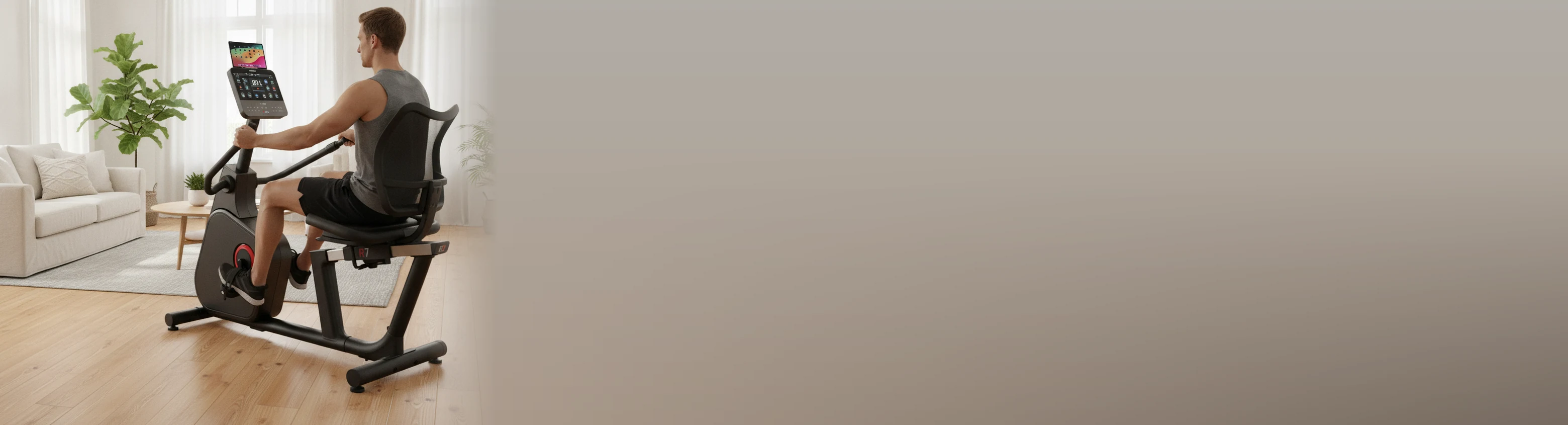
A recumbent ergometer (also recumbent exercise bike, recumbent bike, or seated ergometer) is an exercise bike where you sit reclined with a backrest instead of upright like on a classic ergometer. This relieves pressure on the back, neck, and wrists, making even long sessions comfortable – ideal for those returning to exercise, older users, and anyone with back problems.
- ✓ Free shipping (DE)
- ✓ 30-day right of withdrawal
- ✓ Fast delivery
- ✓ Expert support
Buying guide
Who is it suitable for?
Gentle on joints and back: Thanks to the reclined seating position with a backrest, body weight is distributed over a larger surface area. This takes pressure off the spine and is particularly suitable for seniors, rehab training, overweight individuals, and beginners with little core strength.
Recumbent ergometer or classic ergometer?
The difference lies in the seating posture: On a classic (upright) ergometer, you train in a more athletic posture and engage your core muscles as well. The recumbent ergometer is more comfortable and easier on the back, but less like a road bike. For pure endurance and cardiovascular training, both are equally effective – the key factor is which one you use regularly.
What to look for when buying?
Flywheel mass, resistance, and seat: A higher flywheel mass ensures a smooth, even pedaling motion. Electronically controlled resistance levels allow for precise adjustment and workout programs. Look for a longitudinally adjustable seat so that it fits your leg length, and a comfortable back support cover.
Our model
AsVIVA R7 – 2in1 Recumbent Ergometer & Crossfit
- 18 kg flywheel mass · magnetic resistance system for smooth pedaling
- 24 electronic resistance levels · 10 workout programs incl. watt program
- 2in1: Recumbent ergometer and Crossfit training in one device
- Bluetooth – compatible with Kinomap, Zwift & FitShow

Does a recumbent ergometer make sense?
Distinctly for three groups: for people with back problems, for returning to exercise after an injury or surgery, and for anyone who wants to power through long sessions. The reason is always the same – the backrest supports the upper body. On an upright ergometer, the core supports itself; if you have discomfort there, you stop long before your legs get tired.
It makes less sense if you are looking for an athletic riding feel. Standing up out of the saddle is impossible in a recumbent position, and the motion sequence remains uniform. If you want out-of-saddle interval training, you are better off with a Speedbike.
Recumbent ergometer, recumbent bike, recumbent exercise bike, or seated ergometer?
All four terms refer to the same equipment: an exercise bike where you sit reclined with legs extended forward instead of upright over the bottom bracket. „Recumbent ergometer“ is the technical term because the device measures performance in watts; „recumbent bike“ and „recumbent exercise bike“ are everyday terms, while „seated ergometer“ is used mainly in rehabilitation.
You can recognize a true ergometer by the watt specification. Our R7 operates from 10 to 350 watts – only with this can a training target be maintained, regardless of how fast you pedal.
For seniors and returning to exercise
Two features make the recumbent ergometer the top choice for older exercisers:
- The step-through. You simply sit down instead of lifting a leg over a frame. Anyone who is unsteady on their feet avoids the most critical moment.
- The secure seat. The backrest and wide comfort seat take away the fear of falling off – one of the most common reasons exercise bikes end up unused in the basement.
Plus precise adjustment: 10 watts is low enough to start again after surgery, 350 watts is enough to last for years.
Gentle on the knees
On a recumbent ergometer, the seat carries the body weight, not the legs. There is no impact like with running and no load from your own weight like on a cross trainer. Power is distributed across the entire leg extension instead of in a single impact – which is why this design is so frequently used in rehabilitation.
A tip that is often missing: The seating position must be correct. If the seat is too far forward, the knee bends too much at the rear dead center. As a rule of thumb: at the furthest point, the leg should be almost, but not fully extended. The seat on our R7 is adjustable for this reason.
How much space does a recumbent ergometer need?
A recumbent ergometer is longer and wider than an upright ergometer, but significantly lower in height. The R7 measures 147 × 115 × 75 cm at 46 kg and features transport rollers. The height of 75 cm is its advantage: it fits under any sloped ceiling and obstructs the line of sight in the room far less than a 1,60 m tall machine.
It is not foldable – the device requires a fixed spot. Anyone looking for space-saving in terms of storable equipment will find that with a foldable X-Bike.
Also for upper body training: the arm trainer
Our R7 is a 2-in-1 machine: alongside leg training, the handles can be used for pulling exercises. This engages the back, shoulders, and arms – partially eliminating the main drawback of classic ergometers, which only train the legs.
How recumbent ergometers and upright ergometers otherwise differ can be found in our guide Cross trainer or ergometer? – the comparison broadly applies here as well. The eight-week plan is available for free as a PDF.
FAQ – Frequently Asked Questions
What is a recumbent ergometer?
An exercise bike with a reclined seating position and backrest. The pedals are located in front instead of underneath, allowing you to train comfortably and gently on your back while seated.
Ergometer or recumbent ergometer – which is better?
For endurance, both are equally effective. The recumbent ergometer scores points for back protection and comfort, while the upright ergometer is more athletic and challenges the core more. If you have back problems or want to do long sessions, you're better off with a recumbent ergometer.
What are the advantages and disadvantages of a recumbent ergometer?
Pros: easy on the back and joints, comfortable seat with backrest, safe mounting and dismounting, pleasant even for long sessions. Cons: slightly larger footprint and less athletic seating position than an upright ergometer.
Is a recumbent ergometer suitable for seniors?
Yes, especially well-suited. The step-through design, backrest, and stable seating position make it one of the safest forms of exercise for older adults and rehab training.
Updated 2026
Free training plan: Recumbent ergometer training plan (PDF) – 8 weeks progression, no registration required. All plans