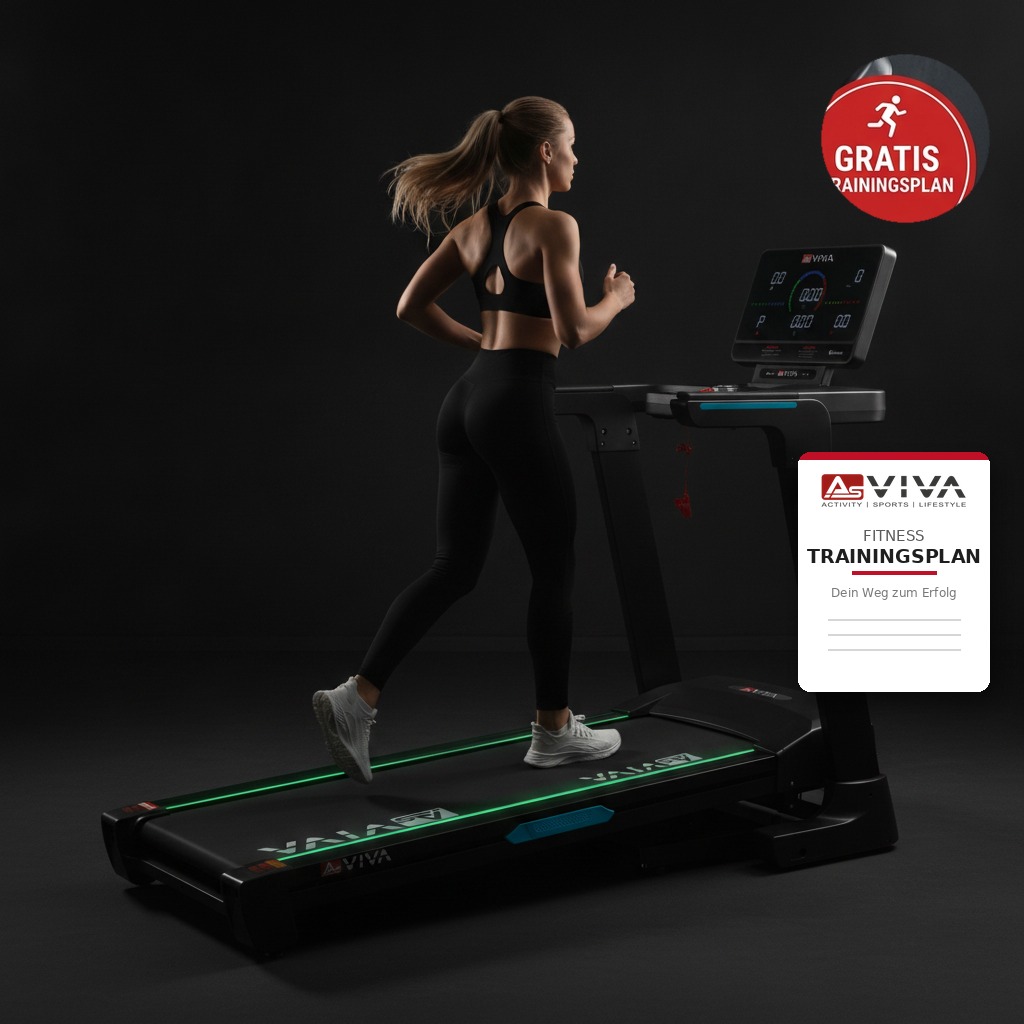
Ever heard of incline walking? If not, we'll explain what it's all about below. Simply put, it is a special form of training on the treadmill. The goal here is to provide a different training stimulus and yes, also to boost fat burning. You don't necessarily run faster or longer, but at an incline. Put simply, incline walking is about walking on an incline, i.e., slightly uphill. We take a closer look at this fitness trend and provide information and tips for the right workout routine.
What is incline walking?
Let's break the term down. The word incline means slope, slant, or grade. Walking means walking. So we are talking about walking on an incline or with a slope or treadmill incline. You are walking uphill. On many treadmills, you can adjust the incline continuously or select predefined incline steps in several individual stages. These are either marked with numbers (Level 1, Level 2, etc.) or the display shows the incline in percent. This type of training is a deliberate low-intensity workout. Speed doesn't matter for now; it's all about effort and endurance..
The benefits of incline walking on a treadmill
Perhaps the most obvious benefit is that walking on an incline targets different muscles than walking on a flat surface. At an incline of approx. 10 percent or slightly more, the leg and glute muscles are engaged in particular. If you pay attention to keeping your torso straight, even your ab muscles come into play. But there are even more benefits:
-
It is completely suitable for beginners because the intensity can deliberately be kept low
-
The goal is to get into fat-burning mode at moderate intensity, because:
-
It boosts fat burning – more fat is burned than without an incline
-
Cardiovascular system training
-
Gentler on joints, back, and knees than regular jogging
What to keep in mind during incline walking
First of all, it's important to warm up properly. Start on the treadmill without any incline and walk for five to ten minutes to warm up your muscles and joints. This is particularly important for this workout because a lot of stretching is exerted on the muscles and tendons at the back of the calves once the treadmill is inclined. You should also make sure you don't start too fast or too intensely. The goal shouldn't be to run out of breath after two minutes and have to pause. Consistency and moderate speed are key here. Make sure your knees don't collapse inward and keep your upper body upright. Your hands and arms swing freely and should never hold onto the side handles. Otherwise, you would likely lose some of the desired body tension. As a beginner, focus on a steady speed. Depending on the treadmill model, advanced users also have the option to select a pre-programmed program where you work through a type of interval and vary the incline frequently. Always start with a small incline. This allows the involved muscles to gradually adapt to the slightly different workload. Don't forget to drink regularly either; a steady intake of water is important here as well.
Incline walking and weight loss – is there anything to it?
Since with incline walking you are not aiming to achieve the highest possible intensity during your workout, but rather a moderate cardio effect, it is well suited for beginners. In addition, this type of athletic activity can be performed several times a week, up to six times a week is said to be fine. The goal is to reach the most effective fat-burning zone. The afterburn effect after the workout is an added bonus. Some even say it's more effective than jogging.
Which treadmill to choose for incline walking
Naturally, only a treadmill with an adjustable incline is suitable for this low-impact workout. Many can be adjusted from 0% to 10%, while higher-quality treadmills often allow an incline of up to 15%. For some, having as long a running surface as possible is also important. At the very least, the running surface should be evenly cushioned so that the entire area can truly be used. In addition, you should pay attention to a solid net weight of the device, which makes it stand even firmer and more securely. A modern computer monitor with a wide selection of preset programs allows for varied workouts. The more powerful the motor, the smoother the workouts run on an inclined running surface. The AsVIVA T18 Pro Bluetooth, for example, is such a high-quality treadmill that easily meets all requirements for an incline walking session.
Ideal workout to increase endurance
In summary, incline walking is a great choice if you still need to build up a basic level of fitness. After warming up, start with a very low incline and increase the slope of the treadmill step by step as needed. Only when you feel safe and realize that the current incline is no longer a major challenge should you move on to the next level. Preset hill climb programs will add variety to your training later on and prepare you for mountain hikes outdoors in nature. This allows you to start training your endurance and the posterior chain muscles in your legs and glutes as early as winter.
Which incline does what?
The percentage on the display doesn't say much unless you can put it into context. As a benchmark:
| Incline | Roughly Equivalent To | Suitable For |
| 0 – 2 % | flat road | Warm-up, cool-down |
| 3 – 5 % | slight incline in town | Getting started, longer sessions |
| 6 – 9 % | uphill dirt path | the range for incline walking |
| 10 – 12 % | steep hiking trail | Glutes and hamstrings, demanding |
| ab 15 % | very steep climb | short intervals, not for beginners |
To put this into perspective: At a 10% incline and 5 km/h, the strain is roughly equivalent to light jogging on a flat surface – just without any impact on the joints. That is precisely why incline walking is recommended so often for knee problems.
One mistake costs half the benefit: Anyone who holds onto the handle transfers part of their body weight to their arms. The incline may be shown on the display, but it won't reach your legs. It is better to reduce the incline and walk hands-free.
Your workout plan to take with you
In our eight-week plan for the treadmill, incline walking is one of the three fixed sessions: 20 minutes at 4 to 5 km/h and a 6 to 12% incline. Free of charge, no registration required.
How the plan is structured can be found in Running Plan for Beginners. All plans: Workout Plans
FAQ: Frequently asked questions about incline walking
What incline makes sense for incline walking?
The typical range is between 6 and 12 percent. Anything below that is just a normal walk, and anything above causes poor posture for most people. Beginners start at 3 to 5 percent and only increase it when the current incline is no longer a challenge.
How fast should you walk during incline walking?
4 to 5 km/h is completely sufficient. Incline walking is a low-intensity workout – the effort comes from the incline, not the pace. Going faster defeats the very advantage you're aiming for.
Is incline walking better than jogging for weight loss?
Not better, but more sustainable for many. For the same duration, calorie burn is lower than with jogging, but the strain on the knees and ankles is significantly less – and if you manage three sessions a week instead of one, you'll end up burning more in the end.
How long should a session last?
20 to 30 minutes at a constant incline, plus five minutes each for warm-up and cool-down on a flat surface. Longer than 45 minutes offers no additional benefit for beginners.
Can you hold onto the handles during incline walking?
Only for safety, not continuously. Holding on transfers body weight to your arms – meaning the incline has little effect on your legs. It is better to choose an incline that allows you to walk hands-free.
What incline can your treadmills reach?
The Smart Run T16 treadmill goes up to 18 percent, the Smart T18 Pro up to 15 percent. A walking pad is usually not sufficient at 5 percent – incline walking requires at least 10 to 12 percent.
Is incline walking also suitable if you have knee problems?
Often yes, because there is no impact: the foot rolls naturally instead of striking hard. The load is distributed across the glutes and hamstrings. However, if you have existing conditions, be sure to consult a doctor first.